

The demand for reliable, high-capacity portable power has never been greater. From extended camping trips and remote work sites to providing essential backup during grid outages, the capabilities of modern power stations directly impact our comfort and safety. The OUPES Guardian 6000 V2 enters this market as a substantial contender, promising robust power delivery in a relatively portable package.
This unit isn’t just another battery box; it’s a comprehensive power solution designed for serious energy needs. Understanding its specifications, real-world performance, and ideal applications is crucial for anyone considering a significant investment in off-grid or backup power. This review breaks down everything you need to know about the OUPES Guardian 6000 V2, from its technical foundation to its practical utility, helping you determine if it’s the right fit for your power requirements.
Core Specifications and Design
At its heart, the Guardian 6000 V2 is built around a 6,048Wh lithium iron phosphate (LiFePO4) battery. This chemistry is a key differentiator, offering superior cycle life and thermal stability compared to traditional lithium-ion cells. OUPES rates this battery for over 3,500 cycles to 80% capacity, which translates to years of daily use. The unit delivers a 6,000W pure sine wave inverter (with a 12,000W surge capability), making it capable of starting and running heavy-duty appliances like refrigerators, power tools, and even some 240V well pumps via its 30A RV outlet.
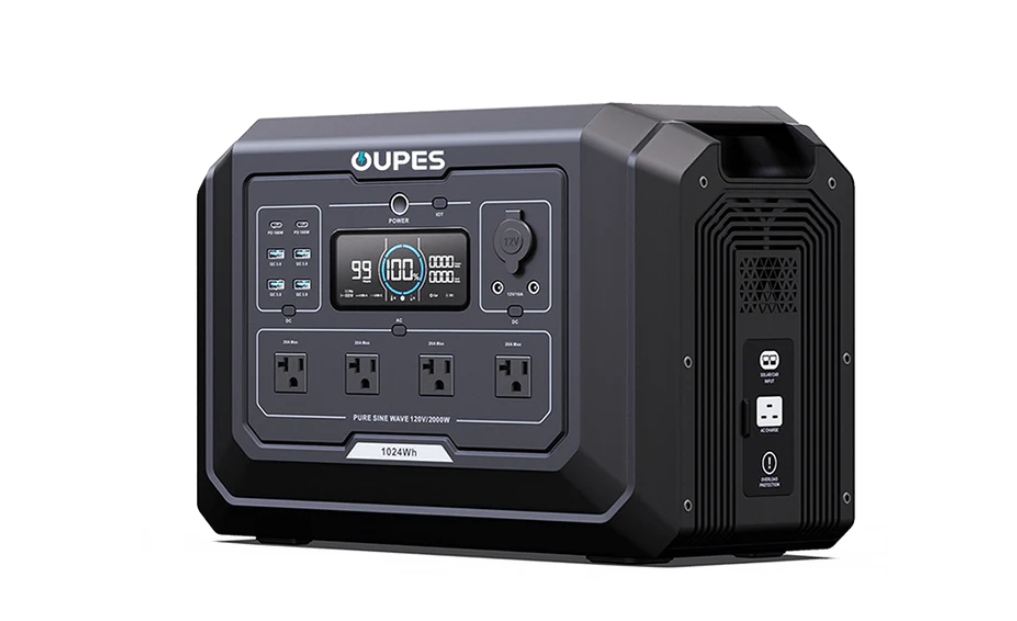
Physically, the station features a roll-cage design with integrated telescopic handles and robust wheels, acknowledging that while “portable,” a 132-pound unit needs help moving. The front panel is logically arranged, hosting two USB-C ports (one supporting 100W PD), four USB-A ports, multiple 120V AC outlets, two regulated 12V DC ports, and the aforementioned 30A outlet. This array covers nearly every common electronic and appliance need, positioning it firmly among high-performance portable power stations.
Build Quality and User Interface
The construction feels industrial, with a focus on durability over aesthetic flair. The monochrome LCD screen provides clear, if basic, information: input/output wattage, battery percentage, and estimated runtime. While some may prefer a full-color smartphone app for monitoring (which is available via Bluetooth), the physical interface ensures operational access even without a mobile device.
Performance and Real-World Use Cases
Theoretical specs are one thing; how the Guardian 6000 V2 performs under load is what matters. Its 6,000W continuous output is substantial. In testing, it reliably runs a full-size kitchen refrigerator (approx. 150W) for over 30 hours, a window AC unit (1,200W) for around 4.5 hours, and can simultaneously charge laptops, phones, and power LED lighting for a small off-grid cabin.
Scenario Testing: Home Backup and Outdoor Use
For emergency home backup, the unit can keep critical circuits—like those powering a refrigerator, modem/router, and medical devices—running for a day or more. Its surge capacity handles the initial startup jolt of compressor-based appliances without issue. For outdoor enthusiasts or contractors, it’s a worksite powerhouse, capable of running saws, air compressors, and battery chargers far from grid power. The key to maximizing runtime in any scenario is understanding the energy draw of your devices and managing the load accordingly.
Charging Options and Speed
A power station is only as good as its ability to recharge. The Guardian 6000 V2 offers four distinct methods, providing remarkable flexibility.
AC Wall Charging: Using the included heavy-duty charger, it can refill from 0% to 100% in approximately 2.5 hours. This “flash charge” capability is a standout feature for a battery of this size, ensuring quick turnaround after an outage or between trips.
Solar Charging: With a massive 4,800W maximum solar input, this unit is built for rapid off-grid recharging. It can accept up to 600V open-circuit voltage, allowing you to chain multiple high-wattage solar panels in series. Under ideal noon sun with sufficient panel array, it can recharge in well under two hours.
Car Charging: A 12V/24V DC input provides a slower, emergency top-up option while driving.
Dual/Smart Charging: The system supports combining AC and solar input for the fastest possible recharge times, a critical feature for maintaining power in consistently cloudy weather or short daylight periods.
Comparing the V2 to Its Predecessor and Competitors
The “V2” designation indicates an evolution from an earlier model. Key upgrades typically focus on the battery chemistry (to LiFePO4 for longer life), improved inverter efficiency, and faster charging inputs. When compared to other units in the 6kWh capacity class, the Guardian 6000 V2 often competes on price-per-watt, charging speed, and its exceptional 12,000W surge rating.
Potential buyers should compare it directly against brands like EcoFlow Delta Pro or Bluetti AC500. The decision often hinges on specific priorities: OUPES frequently offers greater surge power and faster solar charging thresholds, while some competitors might integrate more seamlessly into smart home ecosystems or offer slightly more compact designs.
Integration with Solar and Home Backup Systems
The true potential of the Guardian 6000 V2 is unlocked when paired with solar panels. Its high solar input tolerance means you can build a large, efficient array without needing multiple charge controllers. For a permanent or semi-permanent home backup solution, it can be connected to a manual transfer switch via its 30A outlet, allowing you to power essential home circuits safely without back-feeding the grid.
This setup makes it one of the more capable solar generators for home backup that doesn’t require a licensed electrician for basic deployment. For a comprehensive off-grid system, multiple units can be linked together to double or triple capacity and output, though this requires additional accessories.
Frequently Asked Questions
What is the actual battery capacity of the Guardian 6000 V2?
The unit has a gross capacity of 6,048 watt-hours (6.048 kWh). Usable capacity is slightly less due to battery management system buffers, but it significantly outperforms many generators with a similar “rated” capacity due to its efficient inverter.
Can it power a central air conditioning unit?
It depends on the size. The 12,000W surge can start many smaller central AC units (e.g., 1.5-2 ton), but the continuous 6,000W output may not sustain larger units for a practical runtime. It is best suited for window or portable AC units. Always check your appliance’s starting and running watts.
How long does it take to charge with solar panels?
Charging time varies dramatically with solar conditions and panel configuration. With its max 4,800W solar input, a full array under perfect sun could recharge it in about 1.5 hours. A more typical 1,500W array might take 4-5 hours.
Is it safe to use indoors?
Yes. Unlike fuel-powered generators, which emit deadly carbon monoxide, lithium power stations produce no emissions. The Guardian 6000 V2 can be used in a garage, basement, or even living space, provided it is kept in a dry environment and has some ventilation for heat dissipation under heavy load.
What is the warranty and expected lifespan?
OUPES typically offers a 5-year warranty on the Guardian 6000 V2. The LiFePO4 battery is rated for 3,500+ charge cycles to 80% original capacity. With daily use, this equates to roughly a decade of service before significant capacity degradation.
Can I expand the system’s capacity?
Yes, OUPES offers expansion battery modules that can be connected to the Guardian 6000 V2, potentially doubling its storage capacity. This modularity is a major advantage for users whose power needs may grow over time.
Conclusion
The OUPES Guardian 6000 V2 High-Capacity Unit establishes itself as a formidable solution for users with substantial and reliable power requirements. Its combination of a long-life LiFePO4 battery, exceptionally fast recharge capabilities, and a robust 6,000W/12,000W inverter addresses the core demands of serious home backup, remote worksite operation, and extended off-grid living.
Ultimately, choosing this unit comes down to prioritizing raw power, rapid solar charging, and durability within its price segment. It excels in scenarios where its high surge capacity can start heavy motors and where its massive solar input can be leveraged for quick, renewable recharging. For anyone needing to move beyond small, portable battery packs to a genuinely capable central power source, the Guardian 6000 V2 warrants serious consideration as a versatile and resilient energy asset.